
Uneven rolling, slipping tubes, vibration, speed drift, foam, and inconsistent test results do not always indicate a failed motor. By separating equipment faults from loading, tube, sample, cleaning, and operating errors, you can troubleshoot safely and define the specifications and records a pharmaceutical laboratory needs before accepting a mixer.
Key takeaways
- Test with a known-good tube, reference liquid, and intended fill volume.
- Correct tube size, fill volume, speed, and loading before changing the mixer.
- Record noise, vibration, heat, slipping, and speed loss during each run.
- Escalate drive faults instead of opening or repairing the mixer in-house.
Identify whether the mixer, tube load, or sample caused the failure
Start by isolating one variable at a time. Run the mixer with a known-good tube, the intended fill volume, and a low-risk reference liquid. Record whether it starts, holds speed, rolls smoothly, and completes the programmed run without unusual noise, vibration, heat, or tube slipping.
Use the failure pattern to separate tube roller mixer problems from operating errors:
- The mixer fails with every compatible tube and reference liquid: suspect the drive, motor, controls, rollers, power supply, or speed sensor.
- The mixer works empty but stalls, slips, or vibrates with a full load: check the permitted load, tube diameter, roller spacing, balance, and tube placement before calling it a machine fault.
- Only one tube type fails: inspect its material, outside diameter, cap, seal, label, leakage, and surface condition.
- The equipment runs normally but the sample remains layered, foams, warms, or shows cell damage: assess viscosity, fill volume, speed, angle, run time, and sample sensitivity.
- A blood or cell preparation passes visual inspection but fails hemolysis, viability, or sedimentation criteria: treat the process as unsuccessful, even if no mechanical fault appears.
Repeat the test at the lowest and highest intended speeds with the same load. Compare actual speed, surface temperature, and sample appearance against the equipment record; nominal rpm alone cannot explain all mixing equipment problems.
Stop using the unit for production if it stalls repeatedly, overheats, or changes speed, and document the tube, load, sample, settings, and observed failure.
Correct loading, tube selection, and mixing conditions before changing the machine
Poor mixing usually comes from a mismatch between the tube, load, speed, angle, fill volume, and formulation viscosity—not a defective drive. Correct these conditions before changing a pharmaceutical tube roller mixer.
- Use the specified tube diameter, length, cap shape, material, and rack format. A narrow tube can slip; a wide tube can bind or interfere with its neighbour. Inspect caps, seals, and labels for leaks, protrusions, or contact with the rollers.
- Load tubes symmetrically and stay below the stated tube count and weight. An uneven load causes vibration, stalled rollers, speed fluctuation, and poor bulk turnover.
- Compare the programmed speed with the roller diameter. Surface speed is approximately π × roller diameter × rpm, so identical rpm values can deliver different mixing intensity.
- Increase run time for viscous formulations, but do not assume a longer run fixes inadequate wetting. Very small fills wet the tube intermittently; overfilled tubes lack headspace for rolling.
- Reduce speed or acceleration for protein solutions, surfactants, and cell suspensions that foam or entrain air. Set the angle to keep the sample moving across the intended surface rather than pooling at one end.
| Factor | Common tube roller mixer problems | Correction |
|---|---|---|
| Tube geometry | Slipping, leakage, interference | Match approved dimensions |
| Fill volume | Poor turnover or intermittent wetting | Qualify minimum and maximum fills |
| Viscosity | Incomplete mixing, heating | Challenge the hardest formulation |
| Angle and speed | Foaming, sediment disruption | Use validated settings |
| Load balance | Vibration and stalled rollers | Distribute tubes evenly |
Test the smallest and largest fills, speed limits, maximum load, longest run, tube materials, and highest viscosity—not only water in one tube.
Use a pre-use, during-use, and post-use checklist
A three-stage checklist prevents routine mixing equipment problems from becoming contamination events, foaming, sample damage, or repeat failures.
1. Pre-use: Confirm the roller surface, frame, and controls are clean, dry, and free of residue. Check the power cord, rollers, tube supports, caps, seals, labels, and tube dimensions. Load only compatible tubes within the stated diameter, fill-volume, and weight limits; balance the load and verify the required rolling angle, speed, and duration.
Reject cracked tubes, loose caps, wet labels, or material that could contact the sample.
2. During use: Start at the lowest validated setting and use soft-start acceleration when available. Watch for tube slipping, cap wetting, sloshing, bubbles, uneven rolling, vibration, or abnormal noise. Stop if the tube strikes the frame, the roller stalls, or foam threatens the sample.
Check temperature during long runs because motor heat, bearing friction, room conditions, and bench contact can warm temperature-sensitive material. The displayed speed is not proof of actual speed; record deviations and verify speed under your equipment-control procedure.
3. Post-use: Remove tubes before cleaning, disinfect contact surfaces with the approved agent, and prevent liquid from entering the drive. Record speed, angle, load, run time, sample temperature, and any interruption. Compare results with acceptance checks such as appearance, hemolysis, cell recovery, or required sedimentation before releasing the run.
Repeated failures require documented escalation, not repeated unrecorded cycles.
Specify and qualify the mixer for the actual pharmaceutical process
Before selection, ask medical equipment manufacturers to document the mixer’s suitability for your formulation, container, cleaning method, and production scale—not just its maximum rpm. A pharmaceutical tube roller mixer is low-shear equipment; rolling will not replace an orbital shaker, overhead stirrer, or homogenizer when powders, settled solids, or high-viscosity liquids need substantial dispersion.
1. Request the roller diameter, rotational speed range, acceleration profile, rolling angle, usable tube diameter and length, cap shape, rack format, and maximum tube count. Compare linear surface speed using π × roller diameter × rotational speed; equal rpm does not mean equal mixing intensity.
2. Require a defined operating window for fill volume, headspace, run time, viscosity, temperature, and tube spacing. Ask for evidence showing acceptable uniformity and foam control with your formulation, especially for proteins, surfactants, and cell suspensions.
3. Obtain compatibility documentation for tube and cap materials against the formulation, solvents, disinfectants, temperature, and repeated flexing. Check for swelling, stress cracking, leakage, and closure failure rather than accepting a generic plastic designation.
4. Ask for cleaning instructions, contact-material details, load limits, speed accuracy, alarm functions, maintenance intervals, calibration method, and IQ, OQ, and PQ support. Under 21 CFR 211.63, equipment must be appropriately designed, adequately sized, and suitably located for operation, cleaning, and maintenance.
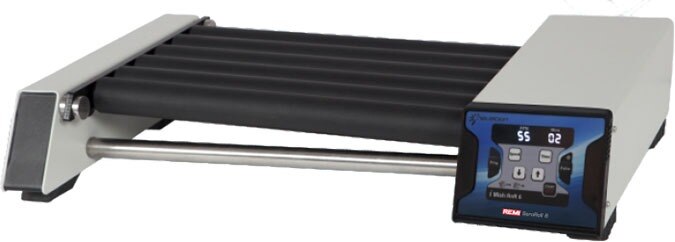
REMI is one manufacturer to ask for these process-specific values rather than relying on a catalogue speed. Select the mixer only after the documented operating range matches your tubes and formulation.
Related product
 | Healthcare Product Our Tube Roller Mixer SeroRol is specially designed & manufactured to achieve uniform consistency in the serological samples, eventually helps in... View product → |
Maintain the drive and escalate faults without unsafe in-house repairs
A clean exterior does not prove that a tube roller mixer is safe. Before each run, check the power cord, plug, housing, rollers, guards, labels, and tube-contact surfaces; remove residue with the cleaning method in the equipment manual.
With power isolated, confirm that rollers turn freely and that no tube fragment or dried product obstructs them.
- Record the displayed speed, run time, load, and any alarm under your equipment-control procedure. If performance depends on speed, use the manufacturer’s approved verification method rather than treating the display as proof of actual speed; 21 CFR 211.68 requires routine checking and calibration of covered automatic, mechanical, and electronic equipment.
- Stop the run if tubes slip, rollers stall, vibration increases, noise changes, the unit overheats, speed fluctuates, or the mixer fails to start. Remove the load, isolate the equipment, label it “out of service,” and document the symptom.
- Do not remove covers, adjust belts, bypass guards, replace wiring, or lubricate parts unless the instructions specifically authorise that task for laboratory staff.
| Laboratory staff may perform | Call authorised service personnel |
|---|---|
| Cleaning, external inspection, approved speed checks, and load verification | Electrical faults, liquid ingress, burning smell, exposed wiring, repeated trips, or a damaged cord |
| Removing tubes after isolation and checking for obstruction | Stalled rollers, abnormal noise, overheating, persistent vibration, or speed deviation |
| Recording tube roller mixer problems and quarantining affected runs | Any repair requiring enclosure access, belt adjustment, component replacement, or calibration |
Medical equipment manufacturers should provide the service boundary, inspection intervals, calibration method, and fault-escalation procedure.
Frequently asked questions
How can you identify whether the mixer, tube load, or sample caused the failure?
Run the mixer with a known-good tube, the intended fill volume, and a low-risk reference liquid. Record startup, speed holding, rolling, noise, vibration, heat, slipping, and run completion.
What should you check before changing a pharmaceutical tube roller mixer?
Verify tube material, diameter, length, closure, fill volume, loading pattern, roller speed, mixing time, and sample viscosity before replacing or adjusting the machine.
What should a tube roller mixer checklist include?
Check tube condition and loading before use, observe speed, slipping, noise, vibration, and heat during use, then clean, inspect, document, and report faults after use.
When should you escalate a tube roller mixer fault?
Escalate repeated speed loss, drive noise, abnormal heat, electrical faults, damaged guards, or persistent slipping. Do not open the drive or attempt unsafe in-house repairs.